

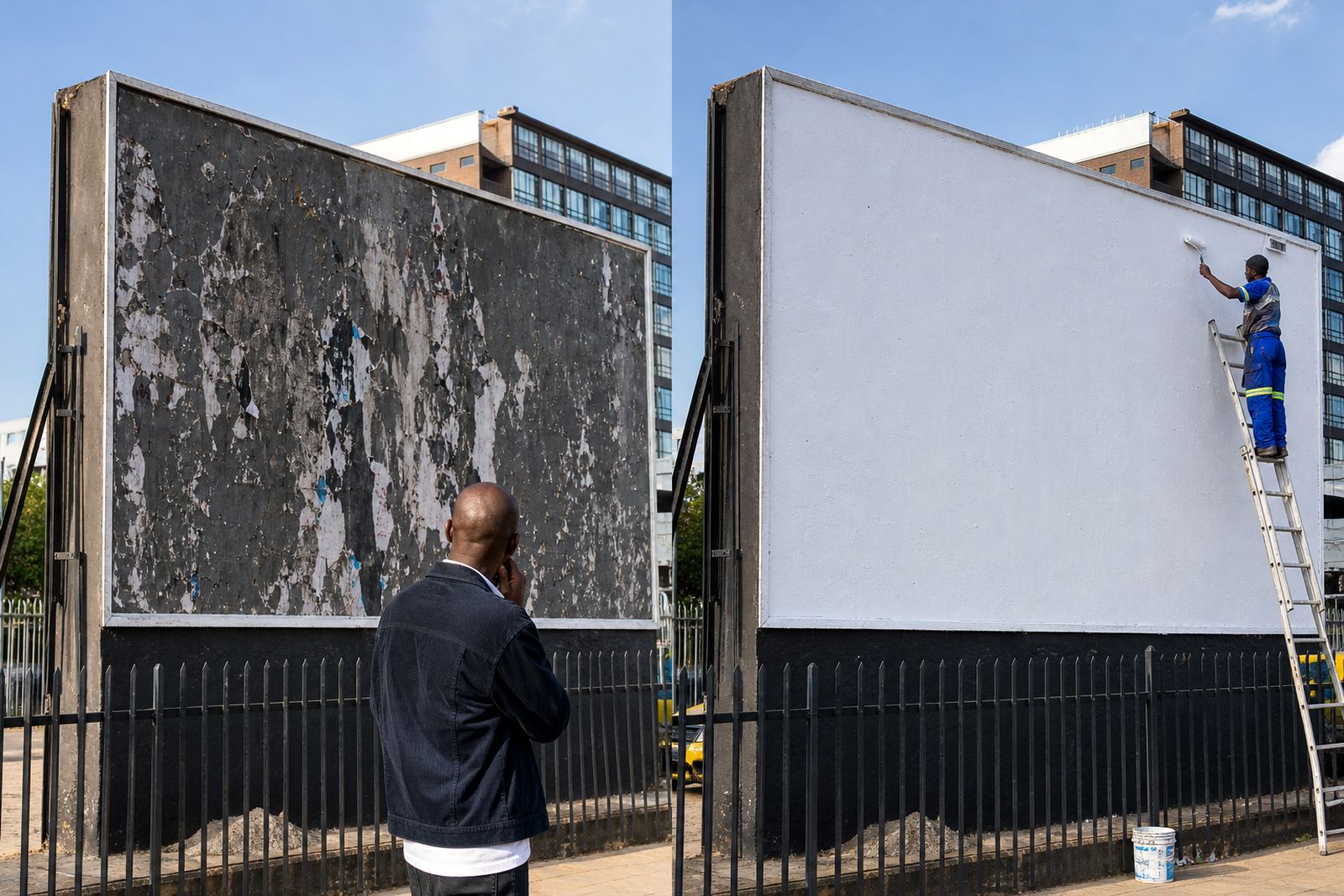
Why stale listings cause problems later
An old listing can look ready on paper while the site itself has changed. A wall may have been painted over, a panel removed for repairs, a neighbour may have added a new structure, or the current owner may no longer be the same person who approved the space last year. If these details are not reviewed, the advertiser ends up working from the wrong information and the property owner is left to explain a booking that no longer suits the site.
In outdoor advertising, accuracy matters because every site has its own practical limits. Height, viewing angle, lighting, access for installers, power supply where needed, and the condition of the surface all shape whether a campaign can run on time. In a city like Johannesburg or along the coast in Durban, weather and building wear can change a space much faster than people expect, especially where sun, moisture and dust are constant.
Start with the basics on every renewal
When a listing comes up for renewal, begin with the basics and do not assume the earlier details still hold. Check the address, the exact placement on the building or wall, the current format size, and whether the space is still available for the same dates. If the site is on a busy street, make sure the approach route for installers still makes sense and that there are no new access barriers or parking restrictions.
- Confirm the property owner or authorised representative is still the correct contact.
- Check that the listing photos match the present condition of the wall or billboard.
- Review any date ranges, booking holds or prior commitments that may affect availability.
- Make sure the surface is still suitable for the planned material and fixing method.
- Revisit any notes about power, lighting, load-shedding backup or night visibility where relevant.
These checks sound simple, but they prevent a great deal of back and forth later. A quick review now is cheaper than having to reschedule a crew or explain to an advertiser that the site no longer matches the brief. It also helps keep the listing trustworthy for everyone involved.
Photos and wording should reflect the real site
Old images are one of the first things to update. A wall that once showed a clean blank surface may now have patching, faded paint, pipework or a tree branch cutting across the view. If the photo was taken in winter, it may not show summer foliage that blocks part of the face. If it was taken at noon, it may hide shadows that matter in the afternoon. Fresh images help advertisers judge the site properly and cut down on avoidable disputes.
The wording should be just as specific. Avoid vague lines that describe a space in broad terms only. State what is actually available, where it sits, what is included, and any local conditions that affect use. If a municipal approval has already been started, say so clearly. If it still needs consent and bylaw approval, say that as well so nobody books under the wrong assumption.
- Replace any photo that no longer shows the full structure.
- Update copy if the surrounding area has changed, such as new scaffolding or road works.
- Remove old claims about lighting, size or access if they have not been verified.
- Use plain language that matches what the property owner can actually support.
Consent, bylaws and owner approval must stay current
For outdoor and wall advertising, the property owner’s consent is essential, and local municipal bylaw approval may also be required. These are not box-ticking items that can be carried over forever. Ownership can change, leases can end, and municipal requirements can shift depending on the area or the type of installation. A listing that looks active but has no current approval is a risk for both the advertiser and the property owner.
Good listing management means checking the consent trail before each booking is finalised. If a site is in Braamfontein, Sandton, Pretoria or Cape Town, the supporting documents may differ from one place to another. The same applies in Durban or Bloemfontein, where local rules and site conditions can vary quite a bit. It helps to keep the approval notes with the listing itself so that whoever handles the next enquiry can see what still needs attention.
When the paperwork is tidy, the booking process is faster and less stressful. When it is out of date, even a very promising site can stall at the last minute. That is why owner consent and bylaw checks need to be part of every refresh, not only the first time a space is added.
A Braamfontein example: what a refresh can fix
Take a wall-space listing in Braamfontein, Johannesburg. The original photos may have been taken before nearby construction started, before a new retail fit-out went in, and before a section of the pavement was fenced off. If the listing is not reviewed, an advertiser may still see it as a clean, central site with simple access. In reality, the installer may now need different working hours, better loading arrangements and a closer look at how the structure meets municipal rules.
Once the listing is refreshed, the picture becomes much clearer. New photos show the current street view, the copy notes the actual access point and the booking team can check whether the owner’s consent is still valid for the next period. That small bit of admin can save days of confusion. It also means the advertiser knows exactly what they are getting, which makes the conversation easier from the start.
A proper refresh does not just help the advertiser. It helps the property owner too, because the site is represented accurately and the booking is more likely to go through without avoidable delays or last-minute changes.
A simple update routine keeps listings workable
Old listings do not need a complete rewrite every time, but they do need a proper review. A short routine makes the work manageable and keeps the marketplace in good order. It also helps when there are several sites in different cities, because the same process can be repeated each time a space becomes available again.
- Recheck site details before each new booking request.
- Replace outdated photos and confirm the surface is still suitable.
- Review consent documents and municipal approval notes.
- Update availability after any installation, repair or hold period.
- Check the listing copy for anything that no longer matches the property.
When this routine is followed, listings stay useful instead of becoming clutter. Advertisers can compare spaces with confidence, property owners stay informed, and campaign scheduling becomes steadier. For a business working across Johannesburg, Pretoria, Cape Town, Durban and Bloemfontein, that kind of consistency is worth a great deal.